“What happens when government transparency fails?
Who should be held responsible?
When the public fights to claim their safety as a basic civil right, will they be heard?”
Overview: Government Accountability
Land Development – How Urban Planning Threatens the Citizens of a Lower Socioeconomic Status in an Urban Area
One of the biggest accountability stories that broke in Louisville Metro Government this summer happened during the spring and summer of 2015 that was revolved around a piece of city-owned property, which was distributed to land developers to build a local food distribution center called the West Louisville FoodPort, located on 30th Street and Muhammad Ali Boulevard, also publicly known as the “west end.”
The outcome of the story itself is an observation of how accountability journalism creates a ripple effect throughout the city but also public platforms that effect all aspects of a community of taxpayers, economics/finance, government agencies, businesses, environment, and residents belonging to varying-income level neighborhoods alike.
Background Information & History of Western Louisville (“The West End”)
First, where is West Louisville and why is this important?
Here’s a quick look at West Louisville by the numbers: There are nine different neighborhoods, more than 65,000 people live there and the average income averages to about $14,000 a year. Majority of the community residents live barely above the poverty line, or live below it. It also has the highest unemployment rate in the city.
“West Louisville is ‘a euphemism for the African American part of town,’ and while most African Americans no longer live in the areas where more than 80 percent of residents are black, the perception is still quite prominent.” -Bill Dakan, Professor of Geography at University of Louisville
West Louisville Neighborhoods
- Algonquin
- California
- Chickasaw
- Park Duvalle
- Parkland
- Portland
- Russell
- Shawnee
Notable Facts About Specific Neighborhoods
- “Algonquin may be described as a crossroads for various social and cultural forces: west Louisville, south Louisville, heavy industry use, and the University of Louisville expansion all converge in the neighborhood.”
- “California was settled in the late 1840’s by German immigrants, with African Americans moving into the area after the Civil War. There are over 20 churches in the neighborhood, 1 elementary school and 2 major parks. “
- “[Park Hill] is currently and has been historically heavily industrial and commercial due to the access of converging national railroads.
- “Russell – There are nearly 40 churches in the neighborhood, 4 public schools and 4 metro parks. In the past, wealthy, working class and poor residents have lived in the neighborhood and prominent public figures built homes on Chestnut St. post Civil War. From the turn of the century to the 1960s, Russell was a well established and popular African American neighborhood, once known as ‘Louisville’s Harlem’. The neighborhood included America’s first library open to African Americans, ‘The Louisville Defender’ publication, and Central High School (once Louisville’s African American High School).”
– per WEST LOUISVILLE NEIGHBORHOOD DATA: Network Center for Community Change
Problems Plaguing West Louisville
Lack of food justice, “food deserts,” failed market businesses
Fighting for “food justice” and equality has been a longtime battle in the West End. With the lack of grocery stores and fresh produce markets to serve a community of over 60,000 residents, West End citizens have dealt with poor health due to unhealthy diets. The West End has been the subject of many research studies and EBT program evaluations that demonstrate the higher need for food justice and market distribution in low-income communities.
“’Food justice’” is often defined as a condition in which all community residents obtain a safe, culturally acceptable, nutritionally adequate diet through a local food system that maximizes community self-reliance and social justice,” as reported by author Danny Burke, Emerson National Fellow per case study Hunger Center: Making the Leap to West Louisville
The point of SNAP (Supplemental Nutrition Assistance Program, also known as food stamps) and community outreach programs is to ensure that food is affordable, and seek outside funding in the form of a grant to reduce costs of weekly shares of high-quality food distribution for recipients. The ability to accept SNAP allows poor communities in the West End to purchase fresh food on a weekly basis. A large range of West Louisville residents rely on food stamps to feed themselves and their families.
SNAP Rolls are contracting in most states, including Kentucky. The state saw a 6.1% drop in people enrolled in SNAP May of 2014. Roughly 136,000 people receive food stamps in Jefferson County/Louisville area. – The Wall Street Journal
Solutions for West Louisville’s Food Injustice and Food Desert
Since SNAP benefits have been made available for qualified citizens in the West End, community outreach programs and nonprofit organizations have been established to find cost-effective ways to ship local food to those in need.
Community Outreach Organizations
- Grasshoppers Delivery – business that sold fresh local food from local farmers to customers in Louisville. They went bankrupt back in December 2013 due to the business never returning profit and only securing a customer base of 500 individuals.
- Community Farm Alliance – Statewide grassroots organization of persons committed to family-scale farming based in Frankfort, KY
- Green Bean Delivery – a regional company that delivers food from to cities in Ohio, Indiana and Kentucky.
- New Roots Fresh Stops – This 501c3 nonprofit organization was established in 2009 in response to the severe food desert plaguing the West End. New Roots has a system called Fresh Stops where “shareholders” (customers) can purchase food from local farmers with SNAP benefits. They currently operate nine fresh stops in different neighborhoods in the West End. 75% of New Roots shareholders come from low-income families.
Environmental Issues in West Louisville, an Industrial Breeding Ground
Fifty Years of Dumping – Chemical Plants, Polluted Air Emissions, Aggravated and Debilitating Health concerns
While fighting poverty, food injustice and inaccessibility to affordable markets, the West End also has a long history of environmental hazards caused by the establishment of railroad tracks, as the area became a heavily industrialized part of Louisville since the Second World War. West Louisville has been home to 11 different chemical plants in the last 50 years.
Rubbertown
Located along the Ohio River, Rubbertown is Jefferson County’s largest industrial complex and has been home to 11 different industrial chemical plants since World War II, and have remained since, which led to its name. Companies include American Synthetic Rubber, Borden Chemical, Rohm and Haas and Zeon Chemicals. Rubbertown is also home to oil, fuel, gasoline, kerosene, naphtha and petroleum coke refineries and terminals, and is currently the largest source of industrial air emissions in Jefferson County, as the area accounts for about 42% of the county’s emissions.
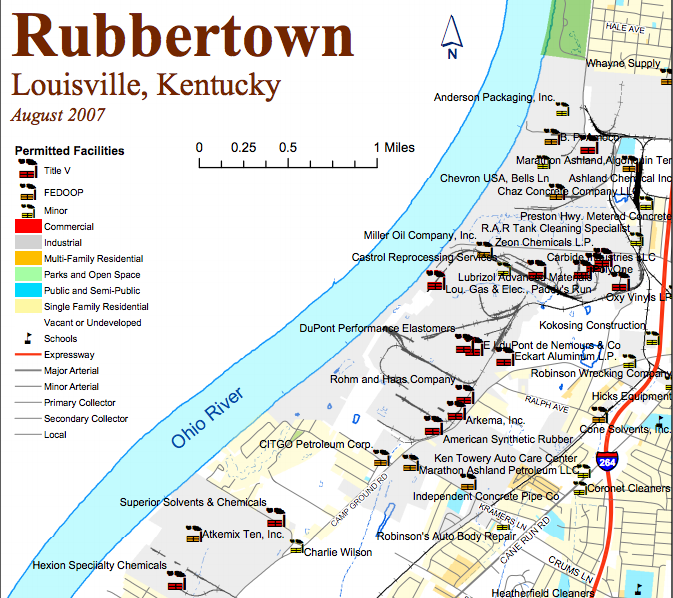
The physical toll Rubbertown had on the West End residents is immense–the community has been fighting airborne illnesses such as cancer, from toxic air emissions and foul odors produced daily at chemical plants.
- Lung, Colon Cancer Rates Higher Near Rubbertown Than Other Louisville Neighborhoods WFPL (2013)
- Timeline: History of Rubbertown, Courier-Journal (2011)
- Rubbertown Odor a Nuisance, But is it Illegal? Hard to Tell WFPL (2013)
…As well as deaths from explosions.
- Two dead after explosion at Rubbertown chemical plant WAVE 3 (2012)
- Rubbertown plant evacuated after chemical reaction WDRB (2011)
West Louisville FoodPort
Louisville’s Mayor Greg Fischer (D) Reveals His Master Plan to Improve Urban Revitalization in the West End
Metro Government had to come up with solutions to address the well-being and concerns of the citizens. In the fall of 2014, Mayor Greg Fischer had proposed a $25 million 24-acre land development project to be built in a vacant plot in the West End–a local food hub market where local farmers, vendors and food-related businesses alike could locate in one place and distribute to customers and create jobs. The food hub was to be designed by architectural firm OMA Designs and was supposed to re-ignite the local economy in an under-invested side of Louisville. Thus, the West Louisville FoodPort was born.
“In all, the FoodPort will employ 200 people, and create 275 construction jobs, according to Seed Capital’s revised plan filed Thursday with Louisville Metro Planning & Design Services.” -Jere Downs for The Courier-Journal May 2015
As soon as Mayor Fischer made the news of a new development project beginning in the West End to address the local food injustice, it hit every local media headline in Louisville.
- Food hub ‘job-generating machine’ for West End (The Courier-Journal, September 2014)
- West End food hub to create 170 jobs (Louisville Business Journals, September 2014)
- West Louisville neighborhoods to be rejuvenated by food hub (WDRB, September 2014)
- Food hub could bring fresh produce, jobs to west Louisville (WLKY, September 2014)
- West Louisville Food Hub to bring businesses, jobs together around local food (WAVE 3, December 2014)
- West Louisville FoodPort gets $1 million grant (Insider Louisville, April 2015)
The West Louisville FoodPort even caught the attention of Prince Charles of Wales, the heir to the British throne, when he visited Louisville with his wife Camilla during the last leg of the trip to the United States. Prince Charles praised Mayor Fischer’s initiative to improve access and sustainability for his citizens. He also applauded the developers leading the project in their efforts to highlight environmental consciousness.
The FoodPort eventually became Mayor Fischer’s pride and joy. Fischer attended Expo Milan in July 2015, an event hosted for a delegation of U.S. and Italian mayors to discuss their roles implementing agricultural and environmental sustainability citywide. He was one of the five U.S. mayors representing the U.S. Conference of Mayors. There, he presented his development project to the delegation.
Mayor Fischer shares West Louisville Food Port plans at international conference & world expo in Italy (LouisvilleKY.gov 2015)
Below Are Rendered Images and Design Layout Plans for the FoodPort
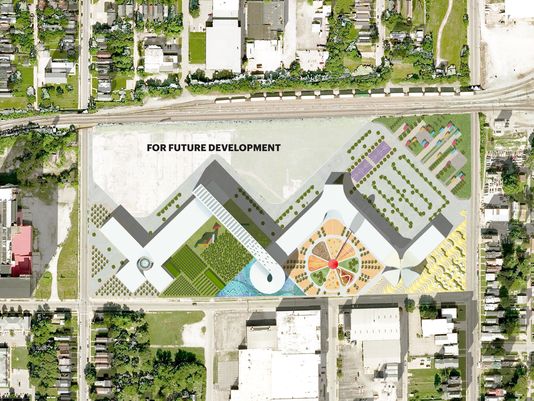
A rendering of the potential site, at 3029 West Muhammad Ali Blvd. Image © OMA
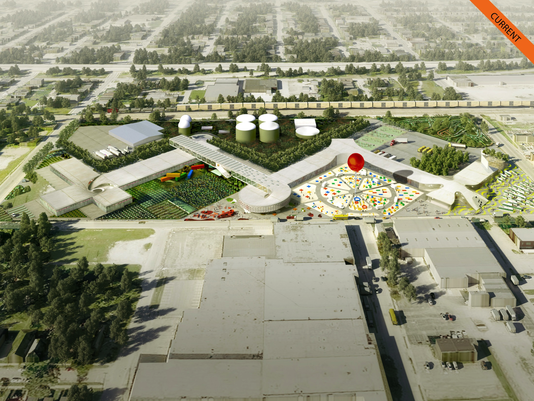
West Louisville FoodPort (Photo courtesy of Seed Capital KY) 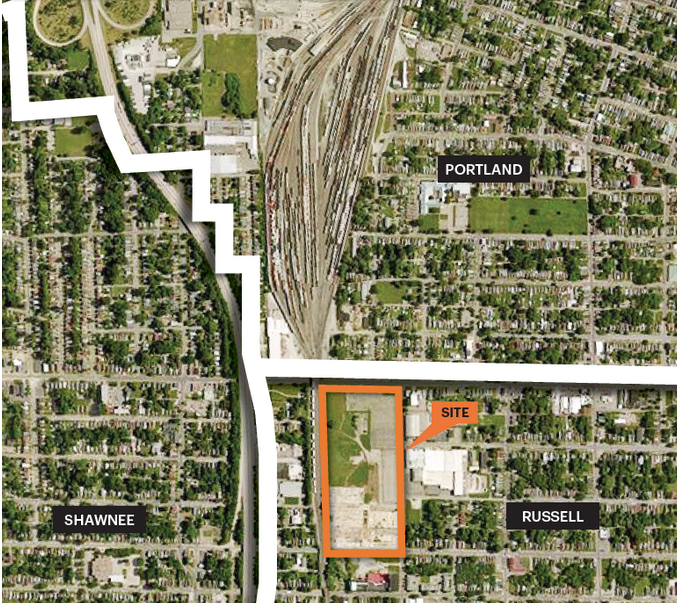
Satellite map of FoodPort site, located in the Russell neighborhood of the West End. 
Sketch of West Louisville FoodPort (Photo courtesy of Seed Capital KY) 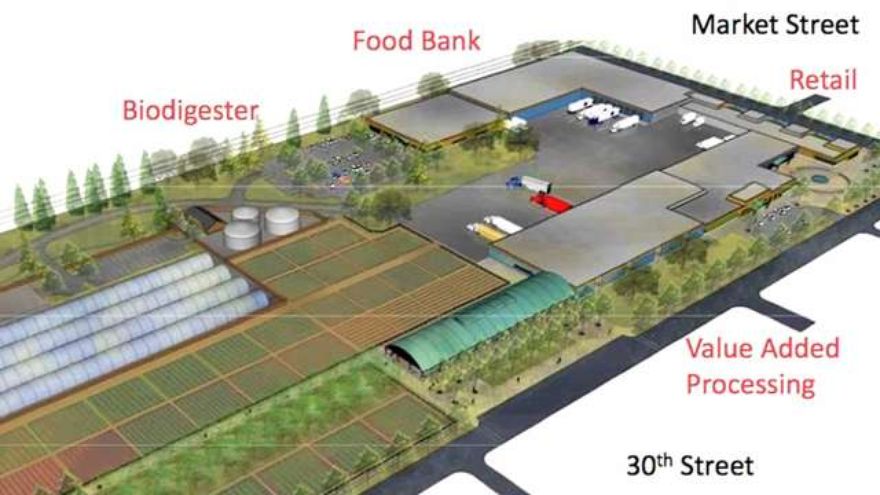
Rendered plot layout of West Louisville FoodPort (Photo courtesy of The Courier-Journal)
Seed Capital KY collaborated with architectural design firm OMA to layout plans for the site.

OMA’s New York office has designed the Food Port as a centralized facility for the growing, selling, and distribution of food to benefit local farmers and the community. “The diversity of program reflects the full food chain, as well as a new foodscape of public spaces and plazas where producers and consumers meet,” commented OMA Partner-in-Charge Shohei Shigematsu, who leads the Alimentary Design studio at Harvard University with Christy Cheng. “The Food Port acts as a catalyst to activate the surrounding neighborhoods, exemplifying one of the complex urban relationships between architecture and food that our studio is investigating.”
Sited on 30th street between Market Street and Muhammad Ali Boulevard, the design integrates several key programs: a kitchen incubator, an urban farm, a recycling facility, and programs to directly engage the public such as a demonstration farm and classrooms. Outdoor spaces include market and food truck plazas and an edible garden. The project is expected to break ground in summer 2016, with businesses opening in phases according to the design’s segmented program layout.” – EXPO MILANO 2015, American Food 2.0
The Catch: Where Public Transparency Had Failed on Mayor’s FoodPort Plans
Metro Councilwoman Opposes Mayor’s Plan for Methane Chemical Plant to Accompany FoodPort
While the FoodPort was touted to become the next biggest investment project in Louisville next to the development of downtown’s Omni Hotel, some members of the metro council board were less than happy about the project. A major player in this issue was District 3 Councilwoman Mary Woolridge, who accused the mayor and his team of hired developers failed to mention their operating system of anaerobic methane bio-digester chemical plants that was to become a part of the West Louisville FoodPort’s “green energy” initiative.
Official Wants Food Hub’s Methane Plant Halted -by Gina Kim and Philip Bailey, The Courier-Journal July 24, 2015
The Courier-Journal was the first to break the news about the Councilwoman’s plan to oppose the development. While she had no issues with building the FoodPort, the councilwoman’s biggest concern was the lack of public transparency on Mayor Fischer’s part. At a private community activism meeting hosted by the Kentucky Alliance Against Racial and Political Oppression on the evening of July 20th, 2015, she spoke out against the anaerobic methane bio-digester plants that was to accompany the FoodPort plans.
“I’m highly offended and insulted that Mayor Greg Fischer showed to put a methane plant in West Louisville. If this proposal needs a permit, we’ll be hauling trash and garbage into West Louisville. I think West Louisville is better than that, but does Greg Fischer think we’re better than that? We need to stand up and let the mayor know we don’t want this. I am the first person will that will cheer for economic development especially when it comes to West Louisville but not this kind. Anything somebody don’t want in this community and in their neighborhood, let’s take it to West Louisville which they already did with Rubbertown, inundated with the whiskey smog that’s being aged in the warehouses here in Miller’s Lane, and I just think at one point in time, enough is enough.” -Councilwoman Woolridge (D3)
What really feared citizens of the West End and the councilwoman was the idea of six anaerobic bio-digester tanks that would be built in residential neighborhoods, and the fact that a minimum of 25-30 trucks of garbage waste would be hauled into the site daily. Furthermore, the FoodPort wasn’t the only site to have proposed chemical plants.
Heaven Hill Distilleries, one of Kentucky’s largest whiskey brand company, located on 15th Street and Maple was to have another set of three anaerobic methane bio-digester plants as well, built by the same company called Nature’s Methane, who were also constructing the same type of plant in the FoodPort. Between 60-70% of the garbage processed at the FoodPort’s tanks will be stillage (near-water solution waste) from Heaven Hill Distilleries.
If these projects were to succeed, the West End would have an additional two different chemical plants, adding to the 11 that Rubbertown already had.
“Questions remain on methane plants” – by Gina Kim for The Courier-Journal published July 24, 2015
How Anaerobic Bio-Digester Plants Work
The anaerobic digester itself is a large, airtight container or tank that contains no oxygen. The tank is filled with organic material (food waste, slops, near-water solution liquids) and is maintained at an optimum temperature for anaerobic bacteria to naturally break down the material. When organic material decomposes, it releases a natural gas, and if that natural gas is untouched by oxygen, it can produce methane. The entire system that prepares the organic material going into the digester and processes the material after digestion is often referred to as an anaerobic digester process.

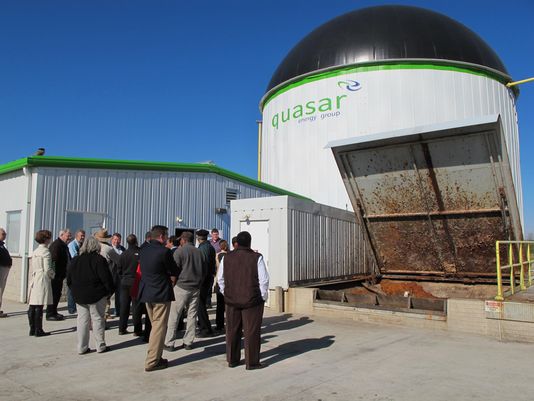
The stainless steel tanks are about 45 feet tall and 70 feet in diameter and has the storage capacity of about 1.5 million gallons. Emissions of the facilities contain biogas that is generally 60% methane and 40% carbon dioxide, as well as small amounts of nitrogen and hydrogen sulfide. The biogas generated would be removed from the tanks and the process first separates carbon dioxide and returns it into the atmosphere. Hydrogen sulfide is removed in a liquid scrubbing process and sent to the sewer system. Once the generated biogas is captured and clean, it will be injected into the LG&E pipeline system which can then be sold and used as a renewable energy source.

The Environmental Risks – Why The West End Are Protesting
- The two methane plants with the anaerobic bio-digesters were to be the first of their kind in the United States in an residential area
- Nature’s Methane, the Fort Wayne-based renewable natural gas division of Star BioEnergy holdings (hired by Seed Capital KY to construct the plants), have never operated this type of chemical plant before.
- Nature’s Methane had also been sued in St. Louis over a similar project. (West Louisville Food Port’s biofuel company in trouble over similar St. Louis project, reported by Louisville Business First, June 2015)
- The risks of fire, explosion and odors will always be present, even if there are low chances. Methane is an odorless, colorless flammable gas, used primarily as fuel to make heat and light. It has the chance to form an explosive mixture in the air at levels as low as 5 percent.
- Hydrogen sulfide, which is part of the decomposition process, unlike methane, has a strong odor. If not operated properly, hydrogen sulfide that is generated in the tanks can be emitted, and the methane gas can explode.
The process of releasing methane chemicals also has an impact on climate change. Some chemicals warm the planet more than others, so methane forms the planet pound for pound, about 25 times more than does carbon dioxide. It takes 25 pounds of carbon dioxide to warm the planet and it takes one pound of methane to warm the planet. One pound of methane is equivalent to 25 pounds of carbon dioxide. If operators lose control of methane there is serious risk for greenhouse gases and global warming, so it is vital to not emit any methane into the atmosphere.
Past Incidents Where Bio-Digester Plants Have Failed Globally and Nationally
- “Wisconsin digester explosion sparks fire” – The Washington Times published August 2014
- “EDPM failure causes anaerobic digester explosion” – Treatment Plant Operator published March 2013
- “Harper Adams AD plant springs another leak” – Farming News published May 2014
- “Harper Adams waste leak pollutes nearby rivers” – BBC UK published February 2013
Along with the fact that there is always a chance for an explosion, not to mention that it will only be adding to the collection of chemical plants in the West End, the location sites for these tanks were to be built in the Russell and California neighborhoods of West Louisville.
Schools Nearby Heaven Hill Plant
After the Courier-Journal began printing the other side of the equation and the concerns of the West End, the issue began catching the attention of all Louisville media. For the record, The Courier-Journal was the first local news platform to break the story, two days before local television stations in the city began to report on it as well. The battle within Louisville Metro Government began to surface, creating a ripple effect across different beats – environment, race/socioeconomics, and education.
Further Investigation
“This looks like a good business idea to those that don’t live in the West End,” said Kathleen Parks, chair of the Kentucky Alliance Against Racist and Political Repression. “There has to be a better way for the powers that be, economic developers and businesses to come up with for a better solution than a methane gas plant in the disguise of a food (hub).” -Kathleen Parks to The Courier-Journal July 23, 2015
The West Louisville community began voicing their oppositions and accusing Mayor Fischer and his team of developers of failing to be open to the public. Chairwoman Kathleen Parks of the Kentucky Alliance Against Racial and Political Repression believed that the West End residents weren’t properly informed about the FoodPort plans.
In order to have any property development project approved through the city, one must submit applications to the Board of Zoning members as well as nine different government agencies, in order to ensure that any project can pass safety tests and regulations or will not interfere with existing government system structures at any site. Then the project developers will be issued a permit to begin breaking ground, but only if they’ve been approved by all agencies. The FoodPort developers and Nature’s Methane have asked Metropolitan Sewer District for a conditional use permit (title 15CUP1022 according to the LouisvilleKY.gov data portal) and submitted applications asking for waivers and variances to start construction.
In essence, the public was in an outrage over the fact that the Board of Zoning Agreement hearings were being held behind closed doors and were approving items daily. Following the mishap, Nature’s Methane and Seed Capital KY agreed to host a public forum under the Councilwoman’s orders. The Q & A session was to be a televised presser at the West End, and members of the council, community activist groups, media and the developers of Nature’s Methane/Seed Capital KY were present. The forerunners of the project were invited to address any questions, concerns and provide information on how they expect to run both facilities.
“Thursday Forum to address methane bio-digesters” – by Gina Kim for The Courier-Journal published August 5, 2015
It was also made aware during the public forum held on August 6, 2015 by Councilwoman Woolridge that Nature’s Methane had applied as a compost facility rather than a chemical gas facility. Thus, they asked for variances applying as a compost location to gain permits faster so they can begin construction. Citizens were appalled, for they felt that these approval meetings should be open to the public, or at least require public input.
Per the Louisville government data portal, inspected by MSD, Planning/Design Services. Application File 15CUP1022, submitted by Nature’s Methane, subsidiary of Jefferson AD LLC


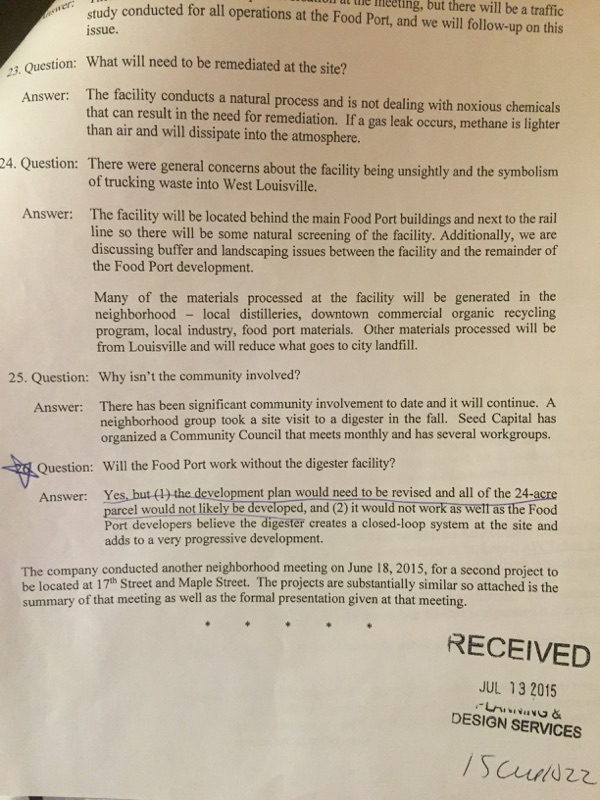
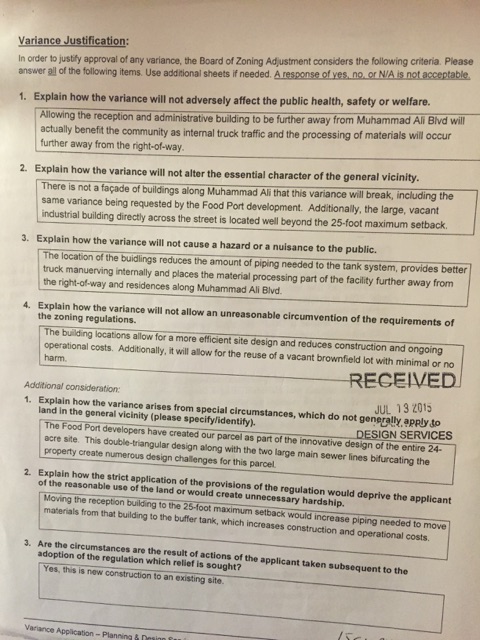

“Bio-digester sparks concern in West End” – by Jere Downs and Gina Kim for The Courier-Journal published August 7, 2015
Key Players in this Development
There were major characters that played a huge role in the outcome of the story this past summer. While there are business developers that the mayor hired to begin breaking ground on this project, each individual involved has some ties with the mayor or are networking connections with each other.
Seed Capital KY: a 501c3 nonprofit organization hired to develop the West Louisville FoodPort. The company has been pursuing tax credits to fund a warehouse, commercial kitchen and office space. Seed Capital are still negotiating final details with food and agriculture-related companies, including a juicery, an industrial food processor and a 2-acre demonstration farm. When Grasshoppers Delivery went bankrupt in 2013, they received a grant to form another brand new nonprofit organization to revitalize the local agriculture production scene in Louisville, thus Seed Capital was born.
Nature’s Methane: division of Star BioEnergy Holdings based in Fort Wayne, Indiana, who was hired to build the anaerobic methane bio-digester plan that will anchor the FoodPort. Nature’s Methane LLC was granted preliminary state approval to receive tax incentives of up to $2.1 million for $27.3 million West End waste power plant. They are also planning to build the second power plant on 17th and Maple Street, for Heaven Hill Distilleries.
Steve Estes: CEO of Nature’s Methane’s parent company Star BioEnergy. Estes has been sued by three contractors for non-payment on a very similar AD plant project in St. Louis, Missouri.
Heaven Hill Distilleries: Kentucky’s (and the nation’s) largest independent family-owned and operated distilled spirits company. Heaven Hill accounts for most of the alcohol production in the state. It is the seventh-largest alcohol supplier in the nation, and the second largest holder of bourbon whiskey in the world. They own several brand labels of spirits including Evan Williams bourbon, Hpnotiq Liquer and Kentucky Supreme Bourbon.
Ties to the mayor
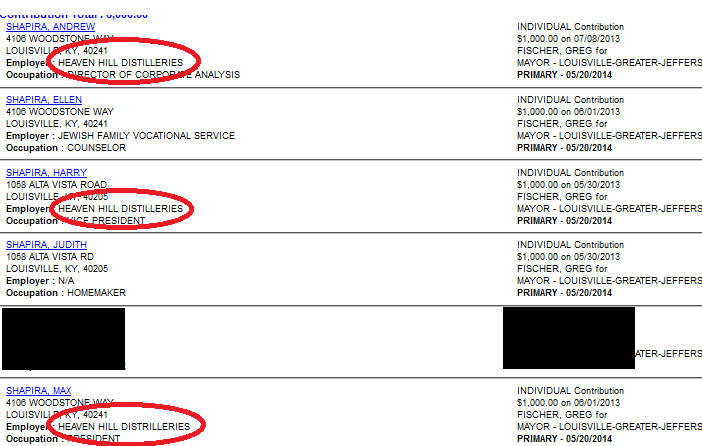
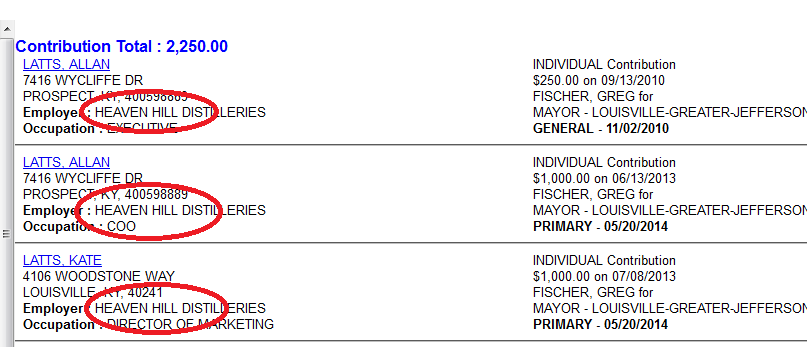
It’s interesting to note that the higher-ups on the board of advisory for Heaven Hill Distilleries have made significant financial contributions over the past couple of years to Mayor Fischer’s campaign. Fischer has also verbally supported the distillery’s initiative to build these chemical plants. So let’s follow the money.
Per the Public Information from Kentucky Registry of Election Finance
From the Kentucky Secretary of State website
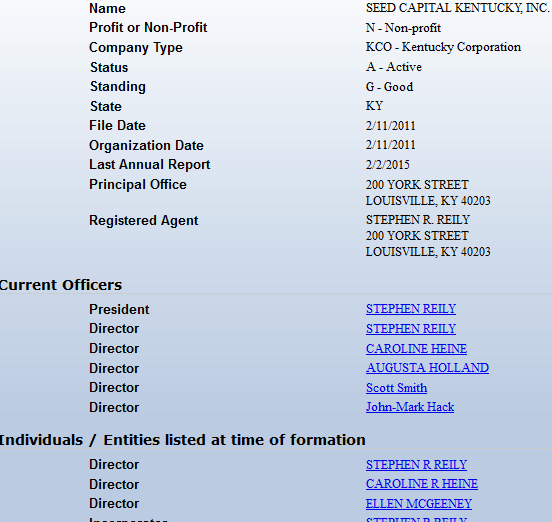
Steve Reily (president) and Caroline Heine (director), both forerunners of Seed Capital KY, are very well connected to some of the wealthiest names in Louisville business. Director Steve Reily is married to historian Emily Bingham of the Louisville Bingham family who controlled Louisville’s daily newspapers, TV station, and two radio station for much of the 20th century. The Bingham’s eventually purchased The Courier-Journal newspaper as well until it was sold to the Gannett Company.
Together, Reily and his wife both made contributions to Mayor Fischer’s campaign as well, from 2009-2014.
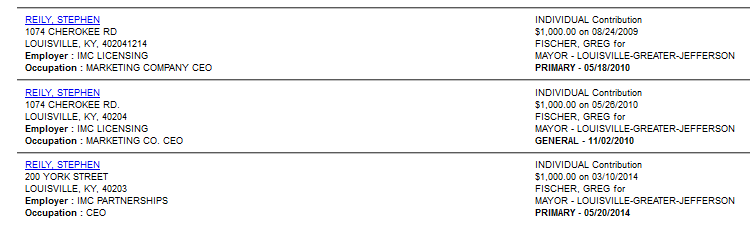
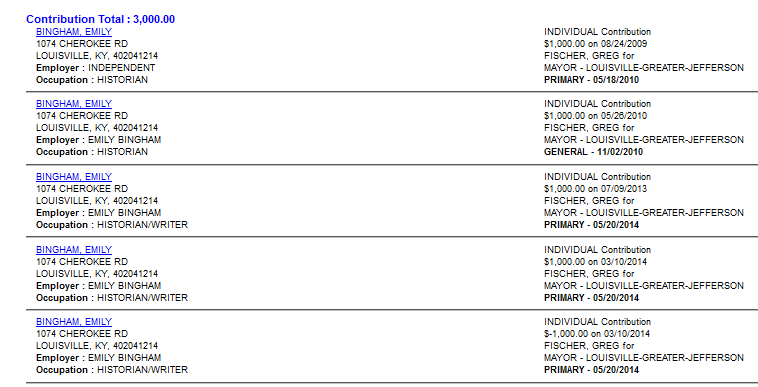
Together, Reily and his wife Emily contributed about $8000 to the mayor’s campaign over the course of 4 years. While it may not seem like a ridiculous amount of donations, it’s still interesting to see their ties with the mayor and where all three parties’ alliances lie.
John Mark-Hack (director) and per the public info found on the Kentucky Registry of Election Finance, also serves as the director of governmental affairs at Kentucky American Water, which is the largest privatized water utility in the state. The company also provides water and wastewater services, so it’s interesting to see that Seed Capital has hired him on board.
Are a team of well-connected network heads plotting together to privatize a government operation that should be performed by a public utility?
A reach or not, these are important issues to discuss. Behind most operations, there is always an ulterior motive, especially more so when development projects evolve without any public transparency.
If Heaven Hill wins the battle and has this methane plant built, that means Mayor Fischer has supported this development for his allies at both Seed Capital and Heaven Hill Distilleries. Whether he’ll finally listen to the public’s concerns about this being built in their community, that will be to follow.
The Final Result and Where FoodPort Project Current Stands
Aftermath: How the Courier-Journal affected the outcome of government plans
Finally after weeks of reports, community forums and press conferences, as of August 13, 2015 can no longer move forward with the project. Seed Capital KY publicly released a statement and said in an on-camera interview to the Courier-Journal that they will be dropping the plans for the anaerobic-methane digester plant and will be submitting a new revised development plan to the city for the FoodPort. The Environmental Protection Agency had also agreed to have a city-wide press conference to lecture on the safeties of the anaerobic digester plants earlier this autumn, per the request of Mayor Fischer.
“FoodPort drops methane plant” – Jere Downs and Gina Kim for The Courier-Journal printed August 13, 2015
“Activists claim FoodPort methane plant victory” – Jere Downs and Gina Kim for The Courier-Journal printed August 16, 2015
However, the fight is far from over. While the FoodPort’s decision to halt the project remains as of today, Heaven Hill Distilleries and Nature’s Methane is still pushing to build their anaerobic bio-digester plants on their location site. Since September 2015, Jefferson County Public School board have also gotten involved, which means this environmental story has crossed over to the education beat as well. Half of JCPS board members have accused the developers for not being transparent with building the plants nearby school campuses while the other half of the JCPS board endorsed the methane plant.
“JCPS board not told about methane stance” – Jim Bruggers for The Courier-Journal printed September 21, 2015
More protests, meetings and stories have been curated following the original story break that first surfaced since July 20, 2015 first reported by Gina Kim. As of today, there are 27 new stories on the issue printed.
To read more about the developments on West Louisville FoodPort and Heaven Hill Distilleries visit The Courier-Journal website.
 Site Title